
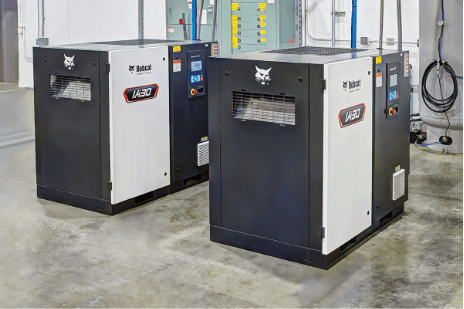
We quote a lot of compressed air systems, and every quote runs into some version of this question. Fixed speed or VSD?
Somebody told the plant manager VSD is more efficient. Somebody else said the electronics are a maintenance headache. The sales rep at the last vendor pushed one direction because that was the machine they had sitting on the floor. Nobody’s giving a straight answer.
So here’s a straight answer. It depends on your plant, specifically, on your demand profile, your system configuration, and what you’re actually trying to optimize for. The compressor technology is one variable. The system around it is the other.
How each one works
Fixed speed is the traditional design. The motor runs at constant RPM whenever the compressor’s on. The machine has two states: loaded (producing air at full rated output) or unloaded (spinning without producing air, still burning around 25 to 30 percent of rated power). It cycles between load and unload based on discharge pressure. Simple, reliable, been around forever.
VSD, or variable speed drive, adds a variable frequency drive (VFD) between the motor and your electrical service. Instead of two states, the motor’s RPM varies continuously to match plant demand. Demand drops, motor slows down, compressor puts out less air. Demand climbs, motor speeds up. The result is that the compressed air system holds discharge pressure in a very tight band, usually within 1 to 2 PSI, because the compressor is constantly adjusting to what the plant is asking for.
That’s the mechanical difference. Now the business decision.
When fixed speed is the right call
If your compressor is loaded most of the time, actually making air 85 percent or more of the shift, fixed speed is doing exactly what it was designed for. There’s no VSD advantage available because there’s no demand variation for the VSD to capture. You’d be paying the VSD premium (usually 20 to 30 percent more capital) for savings that don’t exist in your operating profile.
Steady-state facilities are the classic case: continuous processes without big up-and-down cycles, some textile operations, certain water treatment applications, anything where the air load is essentially flat through the shift.
Simplicity is the other reason. VSDs work, they’ve come a long way, but they add a component that fixed-speed machines don’t have. VFDs fail sometimes. In older buildings with marginal electrical systems, a fixed-speed compressor is one less thing that can go sideways on you.
And if budget is genuinely the deciding factor and the duty profile is close, fixed speed is cheaper upfront, and always will be.
When VSD is the right call
Variable demand. This is where VSD earns its keep. Real production facilities, as opposed to theoretical steady-state ones, usually have demand that varies quite a bit through a shift. Different products running at different times, changeovers, breaks, night versus day load. Any of that variation costs a fixed-speed compressor real energy through load/unload cycling. A VSD tracks the demand and only produces what’s actually needed.
For most variable-demand plants, VSD cuts compressor energy somewhere between 20 and 35 percent versus a fixed-speed equivalent. That’s not a marketing claim, that’s what the numbers work out to when you actually meter both scenarios on the same plant. On a 100 HP compressor running 8,000 hours a year, that difference in operating cost reduction more than offsets the capital premium inside a few years.
If you need tight pressure control, VSD is the answer. Some pneumatic processes are pressure-sensitive, paint work, precision assembly, some instrumentation. Fixed-speed compressors work in a pressure band typically 10 PSI wide. VSD holds you within 1 to 2 PSI. If your quality team has been fighting pressure-related defects, that’s a real difference with real operating cost implications.
And then there’s the trim role in a multi-compressor compressed air system. This is probably the most common right-fit for VSD in bigger facilities. Base-load fixed-speed units carry the steady portion of demand at their efficient full-load point, and a VSD trim machine handles the difference, ramping up and down as demand fluctuates. You get the best of both technologies without paying VSD premium on the base-load machines.
The two mistakes we see all the time
First mistake: VSD-because-VSD. Somebody sold the plant on VSD because “it’s more efficient.” That’s true in most plants, but not in a steady-demand one. If your compressor is loaded 90 percent of the day, the VSD premium bought you almost nothing. The energy savings from variable output can’t materialize when there’s no variation for it to capture.
Second mistake: fixed-speed-because-cheaper in a variable-demand plant. Yes, the fixed unit costs less upfront. But if your plant has real demand swings, the energy waste from constant load/unload cycling can outrun the capital savings inside three or four years. And you’re getting extra wear from all that cycling, so the maintenance profile shifts too.
Neither is a stupid decision on its own. Both are the wrong decision for the plant they landed in, and both could have been avoided by measuring the actual demand profile and doing a proper system assessment before buying the machine.
One thing about VSD nobody tells you upfront
Turndown. Every VSD unit has a minimum speed below which it either can’t run or has to unload and coast. That minimum is typically 25 to 40 percent of rated capacity, depending on the machine. If your low-demand periods, nights, weekends, shutdowns, drop below that minimum, the VSD is going to load and unload just like a fixed-speed compressor would.
A VSD sized for peak demand in a facility with very light off-peak demand doesn’t save nearly as much as the brochure implies. Right-sizing the VSD to the actual demand range that matters, not just the peak, is where a real system quote earns its keep.
This is also why energy efficiency and system optimization work best when you’re looking at the full picture: compressor selection, system pressure setpoints, piping layout, dryer sizing, and controls. Optimizing one piece in isolation often leaves the biggest savings on the table.
How to actually decide
Measure first. Put a flow meter on the header for a week, or pull load/unload data off your current compressor’s controller for a full production week. Look at what percentage of the time it’s loaded. Look at whether demand is flat or bouncing around. Run the energy math with your actual utility rate. Think about how the compressor sits in the overall compressed air system, standalone, or part of a multi-unit setup with base-load and trim.
Then talk to someone who has no reason to push you one direction or the other and who will look at the whole system, not just the unit they’re trying to sell.
Get a straight quote
We quote both fixed-speed and VSD units, across all makes and models. If we think fixed is the right call, we’ll say so, even if VSD is the bigger sale. We’ll also look at your dryers, filters, controls, and piping to make sure the new compressor lands in a system that’s sized and configured to let it perform. That’s what a complete compressed air system quote looks like.
Atlantic Compressor Services
Call 704-369-7700 if you want us to assess your plant and quote it honestly. We cover the Carolinas and Virginia, work on all makes and models, and offer air audits, reliability assessments, energy optimization reviews, preventive maintenance programs, and new equipment installations. We’re a long-term compressed air partner, not just a vendor.
